
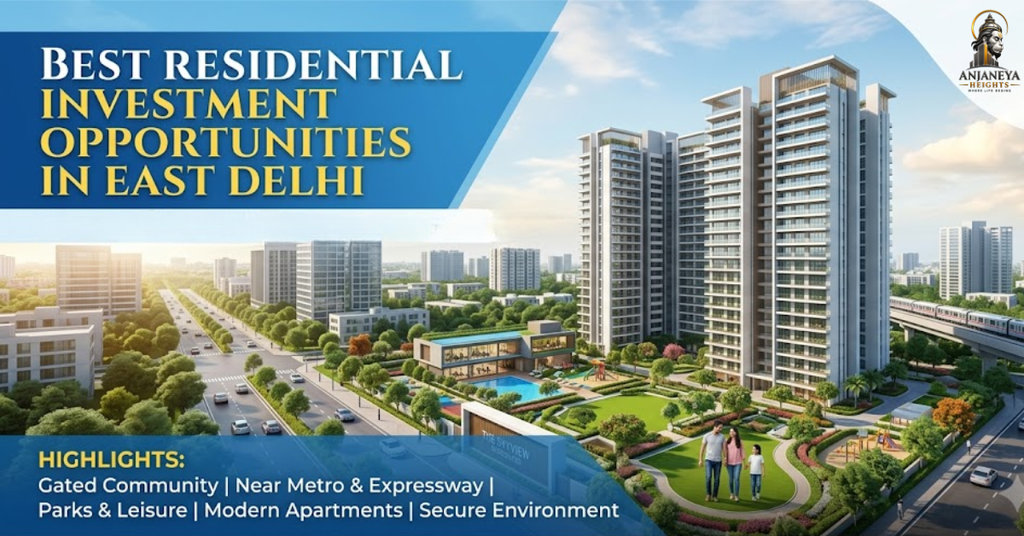
Best Residential Investment Opportunities in East Delhi
East Delhi has emerged as an increasingly interesting destination for residential property buyers and investors who are looking for a combination of connectivity, established infrastructure, lifestyle convenience, and long-term potential. For many years, the region was primarily viewed as a practical residential market where buyers could find comparatively accessible housing options. However, changing infrastructure, improving connectivity, growing demand for quality housing, and the development of modern residential projects have gradually changed the perception of East Delhi.
Today, residential investment in East Delhi is being considered by a wide range of buyers, including first-time investors, families looking for long-term homes, working professionals, and buyers interested in rental income. The region offers a mix of established neighbourhoods, upcoming residential pockets, apartment communities, builder floors, and premium housing options. This diversity allows investors to select a property according to their budget, investment horizon, and objectives.
However, choosing the right residential investment is not simply about finding a property in a popular locality. A successful real estate investment requires careful evaluation of location, connectivity, infrastructure, property type, rental demand, neighbourhood development, construction quality, developer reputation, and the overall price-to-value proposition. Understanding these factors can help investors make a more informed decision and identify residential opportunities that align with their long-term goals.
Why Consider East Delhi for Residential Investment?
Location remains one of the most important factors influencing the value of a residential property, and East Delhi benefits from its position within the larger Delhi-NCR region. The area provides access to several established residential and commercial neighbourhoods while also offering connectivity towards important parts of Delhi, Noida, Ghaziabad, and other employment centres.
The presence of established roads, metro connectivity, public transportation, schools, hospitals, shopping areas, markets, restaurants, and everyday services makes many parts of East Delhi convenient for residential living. This existing social infrastructure can be particularly valuable for investors because tenants and end-users generally prefer neighbourhoods where essential facilities are easily accessible.
Another advantage is the variety of residential options available. Depending on the locality, buyers can explore apartments, builder floors, independent homes, and premium residential developments. This means investors do not necessarily have to follow a single property strategy. Someone looking for rental income may prefer a well-connected apartment, while another buyer may focus on a larger family-oriented property with long-term appreciation potential.
The growing interest in premium housing is another indication of changing buyer preferences. Modern homebuyers are increasingly looking for security, parking, lifestyle amenities, better construction quality, and professionally managed communities. As these expectations increase, residential projects that offer a combination of convenience and quality can attract stronger demand.
Connectivity: A Major Factor Behind East Delhi’s Appeal
For residential investors, connectivity is more than a convenience; it can directly influence the attractiveness of a neighbourhood. A property located close to major roads, metro stations, employment hubs, educational institutions, and commercial areas can potentially appeal to a larger pool of tenants and buyers.
East Delhi benefits from multiple transportation options, including metro connectivity and road networks linking it with other parts of Delhi-NCR. For professionals working in different parts of the capital region, accessibility can make a significant difference to their choice of residence. A home that reduces daily travel time can become more desirable, even when its price is slightly higher than properties located in less-connected areas.
Connectivity can also support rental demand. Tenants often prioritize travel convenience when choosing a home, particularly working professionals and students. Properties located near transportation links may therefore have an advantage when investors are looking for relatively consistent tenant interest.
For long-term investors, it is also useful to consider not only current connectivity but the broader infrastructure direction of the area. Improvements in roads, public transportation, commercial development, and civic infrastructure can influence how a neighbourhood performs over time.
Best Residential Investment Locations in East Delhi
East Delhi is not a single uniform property market. Different neighbourhoods offer different advantages, price points, property types, and buyer profiles. Therefore, investors should evaluate individual localities rather than assuming that the entire region will perform in the same way.
1. Mayur Vihar
Mayur Vihar is one of the prominent residential areas of East Delhi and has long been known for its established infrastructure and connectivity. The locality offers access to schools, healthcare facilities, shopping areas, restaurants, markets, and transportation options, making it suitable for families as well as working professionals.
From an investment perspective, the established nature of Mayur Vihar can be attractive because buyers are not dependent entirely on future infrastructure development. The presence of existing residential communities and supporting facilities contributes to the area’s overall residential appeal.
Properties in and around Mayur Vihar can appeal to buyers who want access to East Delhi while maintaining convenient connectivity towards central Delhi and neighbouring NCR areas. Investors should compare different pockets carefully because property prices, apartment sizes, age of buildings, and rental demand can vary significantly within the broader locality.
2. Patparganj
Patparganj is another important residential market in East Delhi. The area has developed into a well-known housing destination with apartment communities and established residential infrastructure. Its connectivity to different parts of Delhi and proximity to important roads contribute to its residential appeal.
The locality is particularly relevant for investors interested in apartments rather than only independent residential properties. A strong residential population, nearby schools, markets, and everyday services can support end-user and rental demand.
Investors considering Patparganj should examine the age and condition of individual residential projects, maintenance standards, parking availability, floor plans, and the overall quality of the society. In established markets, these details can make a substantial difference to the property’s future attractiveness.
3. IP Extension
Indraprastha Extension, commonly known as IP Extension, is another established residential area that attracts families looking for well-connected housing in East Delhi. Its location provides convenient access to several important parts of Delhi, while the surrounding neighbourhood offers schools, healthcare facilities, markets, and other everyday amenities.
For investors, established residential demand can be an important consideration. Properties in mature neighbourhoods can attract buyers who value immediate access to infrastructure rather than waiting for an emerging locality to develop.
IP Extension can be particularly relevant for investors who prefer established residential communities and are looking at properties with potential rental as well as end-user demand. However, factors such as property age, building maintenance, parking, ownership documentation, and redevelopment potential should be examined before investing.
4. Preet Vihar
Preet Vihar is a well-known East Delhi locality with a strong mix of residential and commercial activity. Its accessibility to markets, schools, healthcare facilities, offices, and transportation options makes it a practical location for urban families and professionals.
The locality can offer opportunities across different property categories, although the investment potential of each property depends heavily on its exact location and characteristics. Investors should compare independent properties, builder floors, and apartments based on rental demand, resale potential, maintenance requirements, and purchase price.
One advantage of established areas such as Preet Vihar is that investors can assess the existing neighbourhood rather than relying entirely on future development projections. This makes due diligence especially important because the investor can examine actual infrastructure, traffic conditions, nearby services, and current property demand before making a decision.
5. Anand Vihar
Anand Vihar is particularly significant from a connectivity perspective. The area is an important transportation and commercial hub, with access to multiple modes of transport and connections towards different parts of Delhi-NCR.
From a residential investment perspective, connectivity can help support rental demand among professionals and other residents who need convenient access to transportation. Properties in nearby residential pockets may benefit from the area’s commercial and transportation ecosystem.
Investors should nevertheless distinguish between properties located directly in high-traffic commercial zones and those situated in quieter residential pockets. For end-users, excessive traffic or noise may reduce appeal, while properties with convenient access but better residential surroundings can potentially offer a stronger combination of convenience and livability.
6. Laxmi Nagar
Laxmi Nagar has a different investment profile compared with premium residential neighbourhoods. It is a densely populated and highly active locality with significant commercial, educational, and residential activity.
The area’s connectivity and established demand can make it relevant for investors interested in rental-oriented properties. Students, working professionals, and small families can contribute to ongoing housing demand, depending on the specific pocket and property type.
Investors considering Laxmi Nagar should pay particular attention to the property configuration, building condition, parking, street accessibility, tenant profile, and local rental levels. Smaller units or properties suited to rental accommodation may follow a different investment strategy than premium family apartments.
7. Shahdara
Shahdara is another established part of East Delhi that has attracted attention because of its connectivity and proximity to various residential and commercial areas. The locality offers a range of housing options and can appeal to buyers seeking relatively accessible entry points into the East Delhi property market.
For investors, Shahdara may be worth evaluating when the objective is to identify properties with a balance between purchase affordability and future residential demand. However, micro-location is extremely important. Properties near major roads and transportation links may have different demand patterns compared with properties located deeper inside local residential lanes.
Investors should also compare the age of the property, title documentation, construction quality, surrounding infrastructure, and redevelopment possibilities before making a purchase.
Apartments vs Builder Floors: Which Is Better for Investment?
One of the most important decisions for a residential investor is choosing the right property format. East Delhi offers different options, with apartments and builder floors being two common choices.
Apartments can be attractive because they often provide access to shared facilities, security, parking, elevators, common spaces, and organized maintenance. Modern apartment projects may also include lifestyle amenities such as fitness areas, landscaped gardens, clubhouses, children’s play zones, and recreational facilities.
Builder floors, on the other hand, can appeal to buyers who prefer greater privacy, fewer neighbours, and potentially larger floor areas. In established localities, builder floors can also provide access to neighbourhoods where large apartment developments may be limited.
The better option depends on the investor’s objective. Someone focused on family tenants may prefer a well-maintained apartment in a secure society, while another investor may prefer a builder floor with a lower purchase price or greater control over the property.
Rather than assuming one property type is universally better, investors should compare purchase cost, rental income, maintenance expenses, resale demand, parking, location, property age, and potential appreciation.
Rental Income Potential in East Delhi
Rental income is an important consideration for investors who want their property to generate regular cash flow. East Delhi’s established residential ecosystem can support rental demand from professionals, students, families, and individuals who want convenient access to workplaces and transportation.
Properties located near metro stations, commercial areas, educational institutions, hospitals, and major roads may have an advantage when attracting tenants. However, proximity alone does not guarantee strong rental performance. The property’s condition, layout, furnishing, parking, security, building quality, and surrounding environment can all influence tenant preference.
Investors should calculate rental yield rather than focusing only on the monthly rent. Rental yield considers the annual rental income in relation to the property’s purchase price and can help investors compare different opportunities.
It is also important to account for vacancy periods, maintenance expenses, property taxes, repairs, brokerage, and other costs. A property with a slightly lower monthly rent may sometimes provide a better investment if its purchase price and maintenance costs are significantly lower.
Capital Appreciation and Long-Term Potential
Capital appreciation refers to the increase in the property’s market value over time. For many real estate investors, long-term appreciation is one of the main reasons for purchasing residential property.
Several factors can influence appreciation, including location, infrastructure development, connectivity, demand, supply, property quality, neighbourhood profile, and broader economic conditions. Properties in established areas may benefit from consistent demand, while properties in developing pockets may offer opportunities linked to future infrastructure growth.
However, investors should avoid making decisions based solely on predictions about future price increases. Real estate markets can vary considerably between neighbouring localities and even between buildings in the same area.
A property with strong fundamentals can potentially remain attractive regardless of short-term market fluctuations. Good connectivity, practical layouts, quality construction, proper documentation, and access to social infrastructure are generally more dependable considerations than speculative promises of rapid appreciation.
Why Social Infrastructure Matters
A residential investment becomes more attractive when residents can conveniently access the services they need. This is why social infrastructure is an important part of property evaluation.
Schools, colleges, hospitals, pharmacies, supermarkets, local markets, banks, restaurants, entertainment options, and recreational facilities can all contribute to the desirability of a residential locality. Families may place greater emphasis on schools and healthcare, while young professionals may prioritize transportation and commercial areas.
East Delhi’s established neighbourhoods benefit from a relatively mature social infrastructure network. This can support both end-user demand and rental requirements.
Investors should physically visit the neighbourhood before purchasing. Online property listings may show the apartment beautifully, but they cannot always communicate the actual traffic, noise, accessibility, road condition, parking situation, or neighbourhood environment. A site visit at different times of the day can provide a more realistic understanding of the location.
The Growing Appeal of Premium Residential Projects
The East Delhi property market is also seeing increasing interest in premium residential developments. Modern buyers are becoming more conscious of lifestyle, security, privacy, construction quality, and amenities, which has increased the demand for better-planned residential communities.
Premium apartments can attract buyers who are willing to pay more for features such as larger layouts, better common areas, controlled access, dedicated parking, landscaped spaces, fitness facilities, clubhouses, and recreational amenities.
From an investment perspective, premium housing can offer a different proposition compared with conventional properties. The target buyer and tenant segment may be narrower, but the property can potentially command a premium when the location, quality, and amenities justify it.
Investors should be cautious, however, about paying a premium purely for branding or marketing. The additional cost should be supported by tangible advantages such as better construction, superior location, useful amenities, quality maintenance, and stronger demand.
Factors to Check Before Investing in East Delhi
Before purchasing any residential property, investors should conduct thorough due diligence. The first step is to verify ownership and title-related documents. The property’s legal status should be clear, and buyers should ensure that there are no undisclosed disputes or claims.
For applicable projects, checking the project’s RERA registration and related information can provide useful details. Buyers should also verify sanctioned plans, approvals, possession information, and other relevant documents.
The physical condition of the property should be evaluated carefully, especially when purchasing an older apartment or builder floor. Check for structural concerns, seepage, plumbing issues, electrical problems, ventilation, natural lighting, and the condition of common areas.
Financial due diligence is equally important. Buyers should calculate the total cost rather than focusing only on the quoted property price. Registration expenses, taxes, parking charges, maintenance deposits, brokerage, renovation, interiors, and ongoing maintenance can all affect the final investment.
Location vs Property Size: What Should Investors Prioritize?
A common dilemma among property buyers is whether to purchase a larger home in a less-established location or a smaller property in a stronger location. In many cases, location can have a more significant influence on long-term demand than simply having additional square footage.
A property with excellent connectivity and strong social infrastructure may attract more buyers and tenants than a larger property in a poorly connected area. This does not mean size is unimportant, but investors should evaluate space in relation to the needs of the target market.
For rental investment, a practical layout can be more valuable than excessive space. For family-oriented investments, a well-designed two- or three-bedroom apartment in a convenient neighbourhood may offer stronger demand than a much larger property that is difficult to access.
The ideal balance depends on the investment strategy, budget, and intended tenant or buyer profile.
How to Choose the Right Property for Rental Investment
Investors primarily interested in rental income should think like tenants. Ask what would make someone choose one property over another.
Accessibility is usually important. Tenants may prefer homes close to metro stations, workplaces, schools, markets, and daily services. A clean and well-maintained building can also make a strong impression.
Parking, security, water supply, power backup, elevators, ventilation, and natural light can influence tenant decisions. Furnished or semi-furnished properties may appeal to certain tenant segments, although investors should compare the additional furnishing cost with the potential increase in rent.
It is also important to understand the local rental market before buying. Compare similar properties in the same neighbourhood rather than relying on city-wide rental averages. This helps establish whether the expected rental income is realistic.
The Importance of Property Age and Maintenance
Property age can significantly influence an investment decision. Older properties may offer lower purchase prices or attractive locations, but they can also involve higher maintenance and renovation costs.
Before purchasing an older apartment, investors should inspect the building’s structural condition, lifts, electrical systems, plumbing, water supply, common areas, parking arrangements, and maintenance history. The condition of the residential society or building can influence both rental demand and resale value.
Newer properties may offer modern layouts and amenities but could come with higher purchase prices. They may also have different maintenance structures. Investors should therefore compare the complete cost and potential returns rather than assuming that newer always means better.
Developer Reputation and Project Quality
For investors considering a new residential project, the developer’s reputation should be carefully evaluated. Construction quality, delivery record, transparency, documentation, maintenance, and after-sales support can all affect the property’s long-term value.
Buyers should research the developer’s previous projects and, where possible, speak with existing residents. Visiting completed projects can provide useful insight into the actual quality of construction and maintenance.
A strong marketing campaign should never substitute for independent due diligence. Buyers should verify all major claims through official documentation and professional advice before making a financial commitment.
Is East Delhi Suitable for First-Time Property Investors?
East Delhi can be considered by first-time investors because it offers a broad range of property types and price segments. Investors do not necessarily have to enter the market through an extremely expensive premium property.
A first-time investor can begin by defining the objective clearly. Is the goal monthly rental income, long-term capital appreciation, personal use, or a combination of these? Once the objective is established, the investor can narrow down suitable localities and property types.
Budget planning is equally important. Buyers should avoid stretching their finances simply because a property appears attractive. Home loan interest, maintenance expenses, registration costs, and unexpected repairs should all be included in the financial calculation.
First-time investors should also avoid rushing into a purchase because of claims about limited-time offers or rapidly increasing prices. Real estate is a significant long-term investment, and adequate due diligence is more important than making a quick decision.
Emerging Trends in East Delhi’s Residential Market
Residential preferences are changing across Delhi-NCR, and East Delhi is also experiencing this shift. Buyers increasingly value efficient layouts, security, lifestyle amenities, parking, green spaces, and convenient connectivity.
The demand for premium and modern residential environments suggests that buyers are becoming more selective about the quality of the homes they purchase. Properties that offer only basic accommodation may face stronger competition from projects that provide better overall living experiences.
At the same time, affordability continues to matter. Not every buyer wants a luxury apartment, and practical housing options remain important. This creates opportunities across multiple segments of the East Delhi residential market.
For investors, understanding these trends can help identify properties that are likely to remain relevant to future buyers and tenants.
Common Mistakes to Avoid When Investing in East Delhi
One of the most common mistakes investors make is purchasing a property solely because the price appears attractive. A low purchase price does not necessarily mean good investment value. The reason behind the lower price should be investigated carefully.
Another mistake is ignoring the property’s exact micro-location. Two properties in the same broad locality can have very different levels of connectivity, noise, parking, infrastructure, and resale demand.
Investors should also avoid relying entirely on verbal promises regarding future infrastructure or appreciation. Any important claim should be verified through reliable sources and official documentation wherever possible.
Underestimating additional expenses is another frequent mistake. Buyers should account for registration, taxes, brokerage, renovation, maintenance, loan costs, and other expenses when calculating the actual investment.
Finally, investors should not skip legal verification. Property transactions involve significant financial commitments, and professional legal assistance can help identify documentation issues before the purchase is finalized.
How to Compare Multiple Residential Investment Opportunities
When several properties appear attractive, creating a structured comparison can make the decision easier. Start by comparing the purchase price and the property’s usable area. Then evaluate connectivity, nearby infrastructure, rental potential, property condition, maintenance costs, and resale demand.
For new projects, compare developers, project specifications, possession timelines, amenities, legal documentation, and total acquisition costs. For resale properties, examine ownership history, building condition, society maintenance, renovation requirements, and transaction documentation.
It is also useful to calculate expected rental yield and estimate potential long-term expenses. A property that generates higher rent but has significantly higher maintenance costs may not necessarily be the better investment.
The final decision should be based on the overall value proposition rather than one attractive feature.
Future Outlook for Residential Investment in East Delhi
East Delhi’s established infrastructure and strategic connectivity provide a solid foundation for continued residential demand. As buyers increasingly prioritize convenience, accessibility, security, and lifestyle quality, well-located residential properties are likely to remain relevant.
The future performance of individual properties, however, will depend on several factors. Infrastructure improvements, neighbourhood development, housing supply, economic conditions, interest rates, and changing buyer preferences can all influence the market.
Investors should therefore think in terms of long-term fundamentals rather than short-term speculation. A property with good connectivity, strong surrounding infrastructure, sound documentation, practical design, and sustainable demand can potentially remain attractive across different market cycles.
Final Thoughts
East Delhi offers a diverse residential investment landscape, ranging from established neighbourhoods such as Mayur Vihar, Patparganj, IP Extension, Preet Vihar, and Anand Vihar to other emerging and developing residential pockets. Each locality has its own characteristics, and the right choice depends on the investor’s budget, objectives, preferred property type, and investment horizon.
The strongest residential investment opportunities are not necessarily the properties with the lowest price or the most impressive amenities. Instead, they are properties where location, connectivity, quality, demand, pricing, and long-term usability come together in a balanced way.
For rental-focused investors, proximity to transportation, employment hubs, educational institutions, and everyday services can be particularly important. For long-term investors, infrastructure, neighbourhood development, property quality, and resale demand deserve greater attention. Buyers looking for personal use may place more emphasis on schools, healthcare, security, lifestyle amenities, and the overall quality of the residential environment.
Most importantly, property investment should be approached with patience and proper research. Compare multiple options, visit properties personally, verify documentation, understand the complete cost of ownership, and seek professional legal or financial advice where necessary. With a well-researched approach, East Delhi can offer a range of residential opportunities worth evaluating for both end-use and long-term investment.