
2 BHK vs 3 BHK: Which Flat Should You Buy?
Buying a home is one of the biggest financial decisions most people make in their lifetime. And once you decide to buy a flat, one question comes up almost immediately:
Should you buy a 2 BHK or stretch your budget for a 3 BHK?
At first glance, the decision seems simple. A 3 BHK gives you an extra bedroom, more space and greater flexibility, while a 2 BHK generally costs less and may be easier to maintain.
But the right choice isn’t always the bigger home.
A young couple may find a well-planned 2 BHK more practical than an oversized 3 BHK. On the other hand, a growing family may regret choosing a 2 BHK if they need an additional bedroom within a few years.
The decision should therefore be based on your current lifestyle, future requirements, budget, location preference and long-term plans.
In this detailed guide, we compare 2 BHK vs 3 BHK across all the important factors—from price and EMI to space, family requirements, maintenance, resale potential and rental demand.
By the end, you’ll have a clearer idea of which configuration makes more sense for you.
2 BHK vs 3 BHK: Quick Comparison
Before getting into the details, here’s a quick overview.
| Factor | 2 BHK | 3 BHK |
|---|---|---|
| Initial Cost | Lower | Higher |
| Monthly EMI | Generally lower | Generally higher |
| Space | Suitable for small families | Better for larger/growing families |
| Maintenance | Easier and usually lower | Higher due to larger area |
| Privacy | Moderate | Better |
| Work-from-Home | May require multi-purpose room | Easier to create dedicated workspace |
| Guests | Limited flexibility | More convenient |
| Future Family Growth | Moderate | Better |
| Resale Appeal | Broad buyer pool | Attractive to families |
| Rental Potential | Strong in many locations | Strong where larger homes are in demand |
| Investment Required | Lower | Higher |
| Best For | Couples and small families | Growing/larger families |
The table gives you a starting point, but the final decision requires a closer look.
What Does 2 BHK and 3 BHK Actually Mean?
The term BHK stands for Bedroom, Hall and Kitchen.
Therefore:
- 2 BHK = 2 bedrooms + 1 hall/living area + 1 kitchen
- 3 BHK = 3 bedrooms + 1 hall/living area + 1 kitchen
However, the number of bedrooms doesn’t tell you the complete story.
Two apartments can both be advertised as 2 BHK but have significantly different layouts and usable areas.
For example, one 2 BHK may have:
- Larger bedrooms
- A spacious living room
- Better storage
- Wider balconies
- Better natural light
- Efficient circulation space
Another 2 BHK may technically have the same number of rooms but feel much smaller because of an inefficient floor plan.
The same applies to 3 BHK apartments.
So while comparing properties, don’t look only at the BHK configuration. Also compare the carpet area, layout, room dimensions, ventilation, natural light, balconies and usable space.
2 BHK vs 3 BHK: Which Is Better for Your Family?
Your family size should be one of the first things you consider.
When a 2 BHK Makes Sense
A 2 BHK can be an excellent choice for:
- Singles
- Newly married couples
- Couples without children
- Small families
- Couples with one child
- Young professionals
- First-time homebuyers
- Investors looking for a comparatively lower entry cost
For a couple, two bedrooms can provide enough flexibility.
One bedroom can be used as the master bedroom while the second can function as a children’s room, guest room or home office.
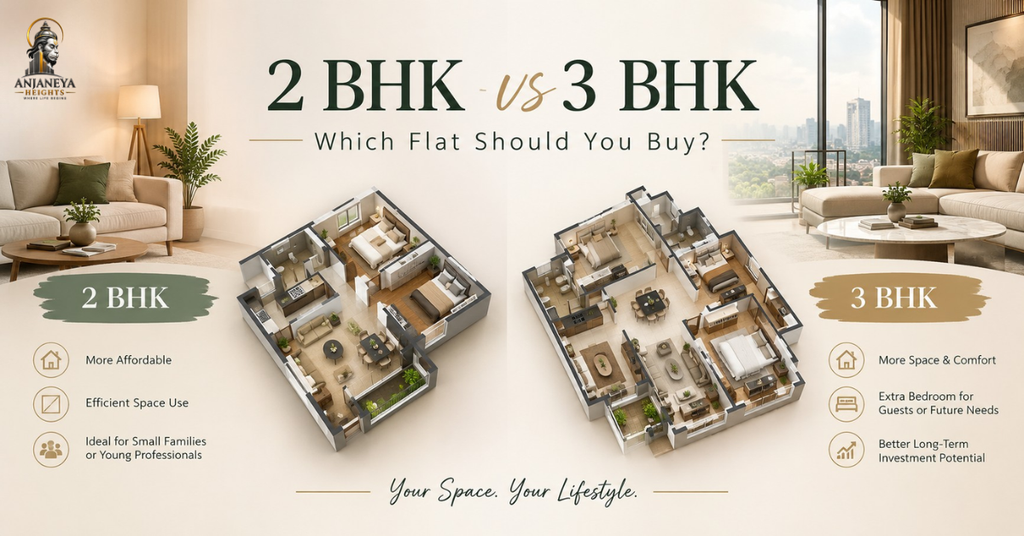
If you don’t expect major changes in your family size, a well-designed 2 BHK can remain comfortable for many years.
When a 3 BHK Makes More Sense
A 3 BHK may be more suitable if:
- You have two or more children
- Parents may live with you
- You frequently host guests
- You work from home
- You need a dedicated study
- You need a separate guest bedroom
- You expect your family to grow
- You want greater privacy between family members
An additional bedroom provides something extremely valuable in a modern home:
Flexibility.
The third bedroom doesn’t necessarily have to be used as a bedroom.
It can become:
- A home office
- Study room
- Guest room
- Kids’ playroom
- Hobby room
- Home gym
- Storage room
- Multi-purpose room
This flexibility can make a 3 BHK more valuable for families with changing needs.
2 BHK vs 3 BHK: The Space Difference
The most obvious advantage of a 3 BHK is space.
But the difference isn’t limited to one additional bedroom.
A larger 3 BHK may also provide:
- Larger living room
- Bigger dining area
- More storage
- Additional bathroom
- Larger balconies
- Better separation between private and common spaces
This can make everyday life more comfortable.
Imagine a family of four living in a 2 BHK.
The children may share one bedroom, while the parents occupy the other. If one parent works from home, finding a quiet place for meetings can become challenging.
In a 3 BHK, the third room can solve this problem.
But there is another important point.
More space is useful only when you can comfortably afford it.
Buying a much larger home and then struggling with the EMI, maintenance and other household expenses can reduce the financial benefits of homeownership.
Carpet Area Matters More Than BHK Size
One of the biggest mistakes homebuyers make is comparing apartments only by their BHK labels.
Instead, compare the carpet area.
A compact 3 BHK can sometimes offer less usable space than a spacious 2 BHK.
For example:
Apartment A
- 2 BHK
- Efficient floor plan
- Larger living room
- Good-sized bedrooms
- Minimal passage space
Apartment B
- 3 BHK
- Smaller bedrooms
- Narrow living area
- Large passage areas
- Limited storage
Although Apartment B has an additional bedroom, Apartment A may feel more comfortable in everyday use.
Therefore, whenever you compare two homes, ask:
“How much usable space am I actually getting?”
Don’t simply ask:
“Is it a 2 BHK or 3 BHK?”
2 BHK vs 3 BHK: Price Difference
Price is one of the biggest deciding factors.
Generally, a 3 BHK costs more than a 2 BHK in the same project because of its larger area.
However, the exact difference depends on:
- Location
- Project
- Developer
- Carpet area
- Floor
- Construction quality
- Amenities
- Parking
- Property age
- Market demand
For example, suppose a project offers:
2 BHK: ₹80 lakh
3 BHK: ₹1.10 crore
The difference is ₹30 lakh.
At first, ₹30 lakh may seem manageable if you focus only on the purchase price.
But the real cost also includes:
- Down payment
- Home loan interest
- Registration charges
- Stamp duty
- Maintenance
- Interior expenses
- Parking charges, where applicable
- Property taxes and other ownership costs
Therefore, the question isn’t simply:
“Can I buy a 3 BHK?”
The better question is:
“Can I comfortably own and maintain a 3 BHK?”
2 BHK vs 3 BHK: EMI Consideration
Your home loan EMI can significantly affect your monthly lifestyle.
A larger apartment generally means a larger loan requirement, assuming other factors are similar.
Before choosing a 3 BHK, calculate:
Down payment + loan amount + interest + EMI + maintenance + other household expenses
Then evaluate whether you can still comfortably save every month.
A home should ideally provide security—not financial stress.
If choosing a 3 BHK means:
- No emergency savings
- Very limited investments
- Difficulty handling unexpected expenses
- No money for travel or lifestyle needs
- Dependence on future salary increases
then a 2 BHK may be the smarter decision.
On the other hand, if your income is stable and the additional EMI is comfortably manageable, the extra space may justify the higher investment.
Should You Stretch Your Budget for a 3 BHK?
This is one of the most important questions.
There is a difference between stretching your budget responsibly and overstretching your finances.
A 3 BHK can be worth paying more for when you have a genuine need for the additional space.
For example:
A couple plans to have children, has elderly parents who may move in later and both partners work from home.
In this situation, the third bedroom has a clear purpose.
But if a couple chooses a 3 BHK simply because “bigger is always better,” they may be paying a substantial premium for space they rarely use.
A simple rule:
Buy the largest home you can comfortably afford—not the largest home the bank is willing to finance.
2 BHK vs 3 BHK for Couples
For many couples, a 2 BHK is an excellent balance.
The master bedroom can be used as the primary bedroom, while the second room can serve multiple purposes.
It could be:
- Home office
- Guest bedroom
- Study
- Dressing room
- Future children’s room
If both partners work outside the home and spend limited time indoors, a 2 BHK may provide sufficient space.
However, couples working permanently or frequently from home may find a 3 BHK more comfortable.
The additional room can create a physical separation between:
Work life and personal life.
Instead of working from the dining table or bedroom, one room can become a dedicated office.
2 BHK vs 3 BHK for Families With Children
This is where the 3 BHK often gains an advantage.
A family with two children may eventually need more privacy.
Children may also need space for:
- Studying
- Playing
- Storing belongings
- Online classes
- Hobbies
If the children are of different age groups or have different routines, separate rooms can become even more useful.
However, a 2 BHK can still work well when:
- Children are young
- The layout is spacious
- The family is comfortable sharing rooms
- The second room can accommodate two children
Your children’s age and your expected family needs over the next 5–10 years should therefore be considered.
2 BHK vs 3 BHK for Joint Families
For a joint family, a 3 BHK usually offers greater comfort.
Multiple generations living together require more privacy.
For example:
- Parents can have one bedroom
- Children can have another
- The couple can use the master bedroom
This arrangement allows everyone to have personal space while sharing common areas.
If grandparents live with you, accessibility is another consideration.
Look for:
- Lift access
- Minimal steps
- Convenient bathroom placement
- Adequate ventilation
- Comfortable bedroom sizes
In such cases, the third bedroom can be more than a luxury—it can significantly improve day-to-day living.
2 BHK vs 3 BHK for Work From Home
Work-from-home has changed how people think about residential space.
A few years ago, a spare room might have been considered optional.
Today, it can be extremely valuable.
A 2 BHK can accommodate work-from-home requirements if one room is flexible enough.
For example:
Bedroom 1: Master bedroom
Bedroom 2: Bedroom + office
However, this arrangement may become difficult if two people work from home simultaneously.
A 3 BHK offers a much better solution:
Bedroom 1: Master bedroom
Bedroom 2: Children’s bedroom
Bedroom 3: Dedicated office/study
This separation can improve concentration and reduce distractions.
Maintenance Cost: 2 BHK vs 3 BHK
A larger home generally means more space to clean, maintain and furnish.
A 3 BHK may involve:
- Higher interior costs
- More furniture
- More electricity consumption
- More cleaning
- Potentially higher maintenance depending on the property’s maintenance structure
- Higher repair and replacement costs over time
A 2 BHK is generally easier to manage.
For people with busy schedules, this can be a meaningful advantage.
If you travel frequently or spend most of your day outside, a smaller home may actually suit your lifestyle better.
Interior Cost: An Often-Ignored Expense
Homebuyers frequently calculate the property price but underestimate the cost of furnishing it.
A 3 BHK requires more:
- Beds
- Wardrobes
- Curtains
- Lighting
- Furniture
- Storage
- Electrical work
- Decorative elements
If you want a premium interior, the additional bedroom can significantly increase your overall setup cost.
For example, an extra bedroom may require:
Bed + mattress + wardrobe + lighting + curtains + side tables + décor
This means the cost difference between a 2 BHK and a 3 BHK isn’t limited to the purchase price.
Your total ownership budget matters.
2 BHK vs 3 BHK: Resale Value
Resale value depends on many factors, including location, property quality, connectivity, project reputation, market demand and apartment size.
Both 2 BHK and 3 BHK homes can have strong resale demand.
However, their buyer audiences can differ.
2 BHK buyers may include:
- Young couples
- First-time buyers
- Small families
- Investors
- Professionals
3 BHK buyers may include:
- Larger families
- Upgraders
- Joint families
- Professionals seeking premium space
- Buyers looking for long-term homes
A 2 BHK can therefore appeal to a wider range of budget-conscious buyers, while a well-priced 3 BHK may appeal strongly to families looking for more space.
The key is to understand the demand in your particular locality.
2 BHK vs 3 BHK for Rental Income
If you’re buying a property as an investment, rental demand becomes important.
A 2 BHK often has an advantage because its lower purchase price can make it more accessible to a larger rental audience.
Typical tenants may include:
- Couples
- Small families
- Working professionals
- Small groups of employees
A 3 BHK can attract:
- Larger families
- Higher-income professionals
- Corporate tenants
- Shared accommodation groups, depending on local rules and demand
But rental yield should not be judged only by monthly rent.
Compare:
Annual rental income ÷ total property cost × 100
Also consider vacancy, maintenance, taxes, furnishing and property management costs.
A cheaper 2 BHK with consistent tenant demand can sometimes make more financial sense than a significantly more expensive 3 BHK.
Location vs Apartment Size: Which Should You Prioritize?
This is one of the most important decisions.
Suppose you have two options:
Option A
3 BHK in a distant location with poor connectivity.
Option B
2 BHK in a well-connected neighbourhood close to:
- Metro
- Schools
- Hospitals
- Offices
- Markets
- Public transport
- Daily conveniences
Which one is better?
For many buyers, the better location may provide more long-term value than the additional bedroom.
A good location can improve:
- Daily convenience
- Commute time
- Rental demand
- Resale prospects
- Quality of life
Therefore, don’t automatically sacrifice location just to get an extra bedroom.
A well-located 2 BHK may be a better purchase than a poorly located 3 BHK.
2 BHK in a Better Location vs 3 BHK in a Cheaper Location
Let’s consider a common situation.
Your budget allows either:
2 BHK in a prime locality
or
3 BHK in an emerging or farther location.
Ask yourself:
- How much time will I spend commuting?
- Are schools and hospitals accessible?
- Is public transport convenient?
- What is the neighbourhood’s development potential?
- Is rental demand strong?
- Would I actually use the third bedroom?
- Which property would be easier to resell?
If the third bedroom isn’t essential, choosing the better location may be the smarter long-term decision.
How Long Do You Plan to Stay?
Your expected holding period can change the answer.
If You Plan to Stay for 3–5 Years
A 2 BHK may make more sense if:
- Your family is currently small
- You may relocate
- Your career location could change
- You want financial flexibility
- You are not sure about your long-term space requirements
Buying a very large home for a short stay can be financially inefficient because transaction and ownership costs can be substantial.
If You Plan to Stay for 10+ Years
A 3 BHK becomes more attractive when you are buying your long-term family home.
Over a decade, your needs can change significantly.
You may have:
- Children
- Elderly parents
- More work-from-home requirements
- More possessions
- Greater need for privacy
A third bedroom provides flexibility for these changes.
This is why future planning is one of the strongest arguments in favour of a 3 BHK.
The “Future-Proof Home” Factor
Imagine buying a 2 BHK today.
It works perfectly for a couple.
Five years later:
- You have two children
- Both parents move in
- Both partners work from home
Suddenly, the same apartment feels crowded.
You may then need to upgrade.
Selling and buying again involves:
- Brokerage
- Moving expenses
- Registration-related costs
- Interior expenses
- Time and effort
- Potential market price changes
If you already know that your family is likely to grow, buying a suitable 3 BHK from the beginning may be more practical.
But future-proofing doesn’t mean buying a huge home just in case.
The future requirement should be realistic.
Don’t Pay for Rooms You Don’t Need
There is another side to future planning.
Some buyers purchase a 3 BHK because they assume they will eventually need it.
Years later, the extra room remains unused.
That means you could be paying more for:
- Loan interest
- Maintenance
- Interior
- Utilities
- Property cost
without receiving proportional value.
The best home is not necessarily the biggest one.
It is the one that provides the right amount of space for your lifestyle and financial situation.
2 BHK vs 3 BHK: Privacy
Privacy becomes increasingly important as families grow.
In a 2 BHK, common spaces may need to serve multiple purposes.
For example:
- Living room becomes study space
- Dining area becomes workspace
- Second bedroom becomes children’s room + guest room
A 3 BHK allows better separation.
One room can remain available for guests without disrupting the family’s routine.
This can be especially valuable in joint families or homes where people follow different schedules.
Storage Space: The Hidden Advantage of a Larger Home
Storage is often ignored while house hunting.
But over time, households accumulate:
- Clothes
- Books
- Kitchen equipment
- Children’s belongings
- Suitcases
- Seasonal items
- Appliances
- Documents
- Sports equipment
A larger 3 BHK can provide more opportunities for storage.
However, don’t assume that a larger apartment automatically has better storage.
Look carefully at:
- Wardrobe space
- Kitchen cabinets
- Utility area
- Built-in storage
- Balcony size
- Dead spaces
- Room shapes
Efficient design can sometimes make a smaller apartment feel much more spacious.
Natural Light and Ventilation Matter More Than an Extra Room
A poorly ventilated 3 BHK isn’t necessarily better than a bright and well-ventilated 2 BHK.
During a site visit, check:
- Direction of windows
- Cross ventilation
- Natural light
- Balcony placement
- Distance from neighbouring buildings
- Room orientation
- Kitchen ventilation
- Bathroom ventilation
A home should feel comfortable during the day without relying entirely on artificial lighting and air conditioning.
When comparing two properties, don’t let the additional bedroom distract you from basic livability.
Floor Plan Efficiency: The Real Difference Maker
Two homes with identical carpet areas can feel completely different.
Why?
Floor-plan efficiency.
An efficient floor plan minimizes wasted circulation space and gives rooms practical dimensions.
Look for:
- Minimal unnecessary passages
- Properly sized bedrooms
- Functional kitchen placement
- Convenient bathrooms
- Good furniture placement
- Adequate storage
- Privacy between bedrooms and living areas
A beautifully planned 2 BHK can sometimes outperform a poorly planned 3 BHK in terms of actual usability.
Common Mistakes Buyers Make When Choosing Between 2 BHK and 3 BHK
1. Choosing Based Only on Size
“Bigger is better” isn’t always true.
Bigger also means:
- Higher cost
- Higher furnishing expense
- More maintenance
- More cleaning
Buy according to your actual requirements.
2. Ignoring the Total Cost
Don’t compare only the property price.
Calculate the complete cost of ownership.
Include:
- Down payment
- Loan
- Interest
- Registration
- Interiors
- Parking
- Maintenance
- Utilities
- Repairs
3. Ignoring Future Needs
Buying a home only for your current situation can create problems later.
Think at least 5–10 years ahead.
4. Buying Too Much Home
The opposite mistake is purchasing a 3 BHK when a 2 BHK would comfortably meet your needs.
Don’t let marketing convince you that more bedrooms automatically mean better value.
5. Ignoring Location
An additional bedroom may not compensate for poor connectivity.
6. Not Checking the Carpet Area
Always understand how much usable space you’re actually buying.
7. Forgetting Resale and Rental Demand
Even if you’re buying for yourself, circumstances can change.
A property with strong market demand gives you more flexibility later.
How to Decide: A Simple 7-Step Framework
If you’re still confused between a 2 BHK and a 3 BHK, use this framework.
Step 1: Determine Your Family Size
Ask:
- How many people will live here?
- Are children planned?
- Will parents move in?
- Will you need a guest room?
Step 2: Estimate Your Space Requirement
List the rooms you genuinely need.
For example:
Couple
- Bedroom
- Living room
- Kitchen
- Office/guest room
A 2 BHK may work.
Family of four
- Master bedroom
- Children’s bedroom
- Additional workspace/guest room
A 3 BHK may be more comfortable.
Step 3: Set a Comfortable Budget
Don’t start with:
“How much loan can I get?”
Start with:
“How much EMI can I comfortably pay?”
This difference can protect you from overborrowing.
Step 4: Compare Locations
Evaluate:
- Connectivity
- Public transport
- Schools
- Hospitals
- Employment hubs
- Markets
- Safety
- Future infrastructure
Step 5: Compare Actual Carpet Areas
Don’t compare only BHK labels.
Compare the usable space.
Step 6: Think About the Next 5–10 Years
Your home should ideally work for your foreseeable future.
Step 7: Calculate the Total Ownership Cost
Include the costs beyond the purchase price.
Only then make the final decision.
So, Should You Buy a 2 BHK or 3 BHK?
There is no universal answer.
The right choice depends on your family, finances, lifestyle and future plans.
Choose a 2 BHK if:
- You’re a couple or small family
- Your budget is limited
- You want a lower EMI
- You prefer a better location over extra space
- You don’t need a dedicated office
- You want easier maintenance
- You’re buying your first home
- You may relocate in the future
Choose a 3 BHK if:
- You have a growing family
- You need more privacy
- Parents may live with you
- You need a dedicated work-from-home room
- You regularly host guests
- You plan to stay for 10+ years
- The additional cost is comfortably affordable
- You want greater flexibility in room usage
2 BHK vs 3 BHK: The Final Verdict
A 2 BHK is often the smarter choice when affordability, location and simplicity are your priorities.
A 3 BHK is often the better choice when space, privacy, family growth and long-term flexibility matter more.
But don’t make your decision simply because one configuration sounds more premium.
Instead, consider three questions:
1. Can I comfortably afford it?
If the 3 BHK puts too much pressure on your finances, choose the 2 BHK.
2. Will I actually use the additional space?
If the third bedroom has a clear purpose, it may be worth paying more.
3. Which property offers the better overall lifestyle?
A well-connected, efficiently designed 2 BHK can be a better home than a poorly located 3 BHK.
Ultimately, the smartest home purchase is not about buying more rooms.
It is about buying the right amount of space at the right price in the right location.
Final Checklist Before Buying Your Flat
Before paying the booking amount, ask yourself:
☐ What is the carpet area?
☐ Is the floor plan efficient?
☐ Is the EMI comfortable?
☐ Have I calculated the complete purchase cost?
☐ Can I afford the interiors?
☐ Does the location suit my lifestyle?
☐ How good is the connectivity?
☐ Will my family grow in the next 5–10 years?
☐ Do I need a dedicated work/study room?
☐ Is there enough storage?
☐ How are natural light and ventilation?
☐ What are the maintenance costs?
☐ What is the rental demand in the area?
☐ What could the resale demand look like?
☐ Am I buying space I actually need?
If you can answer these questions confidently, you’ll be in a much better position to choose between a 2 BHK and a 3 BHK.
Conclusion
Choosing between a 2 BHK and a 3 BHK isn’t simply a choice between a smaller and a bigger apartment.
It is a decision about how you want to live, how much you want to spend and how your needs may change in the future.
For a young couple or small family, a thoughtfully designed 2 BHK can offer excellent value without putting unnecessary pressure on the budget.
For a growing family, joint family or work-from-home household, a 3 BHK can provide the extra privacy and flexibility that becomes increasingly valuable over time.
The key is to look beyond the number of bedrooms.
Compare the carpet area, layout, location, total cost, monthly affordability, family requirements and long-term plans before making your decision.
Because when it comes to buying a home, the best property isn’t necessarily the biggest one.
It’s the one that fits your life—and your finances—today and tomorrow.