
Infrastructure Development in East Delhi: How Connectivity and Urban Growth Are Shaping the Region
East Delhi has been steadily transforming from a primarily residential zone into a more connected and increasingly important part of the National Capital Region. With improvements in road networks, public transportation, metro connectivity, commercial infrastructure, civic facilities, and urban development, the region is becoming more accessible for residents, professionals, businesses, and property buyers.
Infrastructure development plays a major role in determining how a neighbourhood grows. Better roads can reduce travel time, improved public transport can make daily commuting easier, and upgraded civic infrastructure can improve the overall liveability of an area. For East Delhi, these changes are particularly significant because of its strategic location between central Delhi, Noida, Ghaziabad, and other important parts of the NCR.
For people considering residential property in East Delhi, understanding these infrastructure changes is important. Development does not only affect convenience; it can also influence rental demand, residential preferences, commercial activity, and the long-term attractiveness of different localities.
Understanding the Importance of Infrastructure Development in East Delhi
Infrastructure is much more than the construction of roads and flyovers. It includes transportation systems, metro networks, drainage, electricity, water supply, pedestrian facilities, public spaces, healthcare, education, and commercial infrastructure.
In a densely populated urban region such as East Delhi, infrastructure has a direct relationship with everyday life.
A well-connected locality allows residents to reach workplaces, schools, hospitals, shopping areas, and entertainment zones more conveniently. Similarly, better civic infrastructure can make neighbourhoods more comfortable and functional.
East Delhi also has an important geographical advantage. It connects Delhi with major employment and commercial centres across the NCR, particularly Noida and Ghaziabad. This makes improvements in connectivity particularly relevant for people who travel between these regions on a regular basis.
Road Connectivity: A Major Part of East Delhi’s Growth
Road infrastructure remains one of the most visible aspects of urban development.
Several important roads and corridors connect East Delhi with Central Delhi, South Delhi, Noida, Ghaziabad, and other parts of the NCR. As traffic volumes have increased over the years, road improvement and corridor development have become important components of the region’s infrastructure planning.
Better road connectivity can have several effects on residential neighbourhoods.
First, it can reduce dependence on smaller internal roads. Second, improved arterial roads can provide easier access to major employment hubs. Third, better connections between different parts of the city can make previously less-accessible neighbourhoods more attractive to homebuyers.
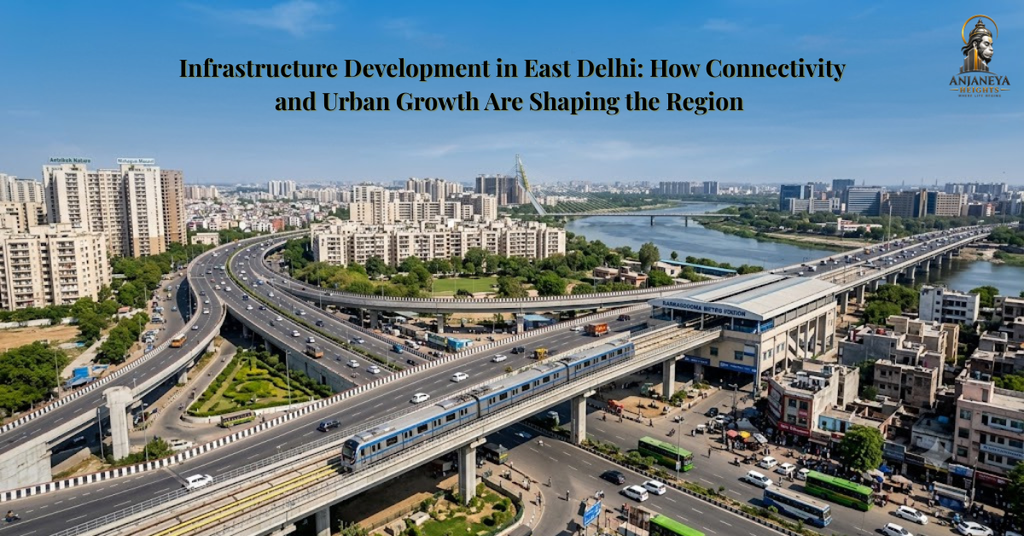
For residential buyers, however, road connectivity should be considered alongside traffic levels. A property located close to a major road may offer excellent accessibility but can also experience higher traffic, noise, and congestion. Therefore, buyers should evaluate both accessibility and the immediate residential environment.
Metro Connectivity and Public Transportation
Public transportation is another critical component of East Delhi’s infrastructure.
Delhi Metro connectivity has played an important role in integrating East Delhi with the wider Delhi-NCR region. Metro stations provide residents with an alternative to private vehicles and can make commuting considerably more convenient.
For working professionals, students, and tenants, proximity to public transportation is often an important factor when choosing a home.
Metro connectivity can also influence the development pattern of surrounding neighbourhoods. Areas around stations may experience increased footfall, retail activity, offices, rental demand, and supporting services.
However, being “near a metro station” does not automatically mean that every property will benefit equally. The actual walking distance, availability of last-mile transport, road crossings, station accessibility, and neighbourhood infrastructure should all be considered.
Improved Connectivity Between East Delhi and Noida
One of the major advantages of East Delhi is its proximity to Noida.
Noida has developed into an important commercial and employment hub, with offices, IT companies, educational institutions, retail centres, and business districts attracting workers from different parts of Delhi-NCR.
For residents of East Delhi, connectivity towards Noida is therefore particularly important.
Improved road and public transportation links can make cross-border commuting more convenient. This can increase the appeal of East Delhi for professionals who want access to Noida’s employment centres while preferring to live within Delhi.
The same connectivity can also benefit rental housing. Professionals working in Noida may consider residential neighbourhoods in East Delhi depending on commute times, rental prices, amenities, and transportation options.
Flyovers, Corridors and Traffic Management
Flyovers and major road corridors are generally developed to improve traffic movement at important junctions and reduce congestion.
For East Delhi, such projects can improve connections between residential areas and major arterial roads. They can also help streamline traffic movement towards neighbouring parts of the NCR.
However, the impact of a major infrastructure project is not always uniform across every locality.
A corridor may significantly reduce travel time for one route while having limited impact on an internal residential pocket. Similarly, areas immediately surrounding large transportation corridors may experience increased commercial activity while quieter residential lanes may remain relatively unchanged.
This is why homebuyers should look beyond headlines about infrastructure projects and examine how a specific property is connected to the infrastructure.
Civic Infrastructure and Everyday Liveability
Transportation is only one part of urban infrastructure.
For residents, basic civic services are equally important. Water supply, drainage, electricity, waste management, street lighting, footpaths, parks, and road maintenance all contribute to neighbourhood liveability.
East Delhi includes a large number of established residential colonies as well as areas undergoing redevelopment and gradual urban transformation. The quality of civic infrastructure can therefore vary considerably between localities.
A neighbourhood with good connectivity but inadequate drainage or poorly maintained internal roads may not provide the same residential experience as a locality where both transportation and civic infrastructure are well developed.
Homebuyers should therefore inspect the neighbourhood during different times of the day and, where possible, during different weather conditions.
Pedestrian Infrastructure and Walkability
Modern urban infrastructure increasingly focuses on pedestrians as well as vehicles.
Footpaths, pedestrian crossings, street lighting, safe access to metro stations, and walkable commercial streets can significantly improve everyday convenience.
This is particularly relevant in East Delhi because many residents rely on a combination of walking, metro, buses, e-rickshaws, autos, and private vehicles.
A home that is technically close to a metro station but requires residents to cross unsafe or poorly maintained roads may not provide the same practical advantage as the distance suggests.
For residential buyers, walkability should therefore be considered as part of connectivity.
Commercial Development Supporting Residential Growth
Residential development rarely happens in isolation.
As population and connectivity improve, supporting commercial infrastructure generally becomes increasingly important. Local markets, supermarkets, restaurants, banks, healthcare facilities, gyms, educational centres, and daily-needs stores all contribute to the functionality of a residential neighbourhood.
East Delhi already has several established commercial and market areas. Continued infrastructure improvement can strengthen connections between residential and commercial zones.
For homeowners, this can mean greater convenience. For landlords, access to employment centres and everyday amenities can influence tenant preferences.
This is one reason infrastructure development and residential demand are closely connected.
Healthcare Infrastructure in East Delhi
Healthcare access is another important consideration for residential buyers.
Hospitals, clinics, diagnostic centres, pharmacies, and emergency medical facilities form an essential part of a well-developed urban neighbourhood.
Established parts of East Delhi benefit from access to a range of healthcare facilities, while continued urban development can increase demand for additional neighbourhood-level medical services.
For families, proximity to reliable healthcare can be an important factor when comparing residential locations.
When evaluating a property, buyers should consider both the distance to nearby clinics and the accessibility of larger hospitals for specialised or emergency treatment.
Education and Institutional Infrastructure
Schools, colleges, coaching centres, libraries, and other educational institutions also influence residential preferences.
Families often prefer neighbourhoods that provide convenient access to schools and educational facilities. This can make established residential areas particularly attractive for long-term occupants.
East Delhi’s connectivity to other parts of Delhi and the NCR also gives residents access to a broader network of educational institutions beyond their immediate neighbourhood.
For families buying homes, commute time to schools should be evaluated alongside workplace connectivity.
Parks and Open Spaces
Urban infrastructure is not limited to concrete development.
Parks, green spaces, recreational areas, and community spaces can significantly influence residential quality of life.
Established neighbourhoods in East Delhi often include local parks and community spaces that provide residents with areas for walking, exercise, children’s activities, and social interaction.
As urban density increases, maintaining and improving such spaces becomes increasingly important.
For homebuyers, the presence and condition of nearby parks can be a useful factor when comparing similar properties.
Infrastructure and Residential Property Demand
Infrastructure development can influence residential demand in several ways.
1. Improved Accessibility
Better connectivity makes a locality easier to reach from employment centres and important parts of the city.
2. Reduced Commuting Friction
Efficient transportation can make daily travel more manageable, particularly for professionals commuting across Delhi-NCR.
3. Better Access to Amenities
Infrastructure improvements can encourage commercial and service-sector development around growing residential areas.
4. Greater Rental Convenience
Tenants often prioritise connectivity. Localities with access to metro stations, major roads, workplaces, markets, and educational institutions can attract a broader tenant pool.
5. Changing Buyer Preferences
As infrastructure improves, buyers may become more willing to consider neighbourhoods that previously received less attention because of connectivity limitations.
It is important to remember that infrastructure development does not guarantee a specific property-price outcome. Property values are influenced by multiple factors, including supply, demand, property condition, location, legal status, amenities, economic conditions, and broader real-estate trends.
Which Parts of East Delhi Can Benefit From Better Connectivity?
The impact of infrastructure is highly localised.
Neighbourhoods closer to major roads and metro corridors may benefit differently from areas located deeper inside residential zones.
Areas with a combination of:
- Metro accessibility
- Strong road connectivity
- Established markets
- Schools and healthcare facilities
- Employment hubs nearby
- Good internal roads
- Reliable civic infrastructure
can offer a practical combination of accessibility and everyday convenience.
However, buyers should assess each locality individually rather than assuming that an infrastructure project will affect an entire district equally.
East Delhi as a Residential Destination
East Delhi has traditionally offered a mix of established colonies, plotted housing, builder floors, apartments, and redevelopment opportunities.
Its location gives residents access to multiple employment and commercial centres.
For some buyers, the attraction lies in staying within Delhi while maintaining relatively convenient access to Noida and Ghaziabad. For others, established neighbourhoods, markets, schools, and transportation options may be the primary reasons for considering the region.
The infrastructure story adds another dimension to this residential appeal.
As connectivity improves, residents can potentially access a wider area of the NCR without necessarily relocating closer to every employment hub.
What Infrastructure Development Means for Homebuyers
Homebuyers should look at infrastructure from a practical rather than purely speculative perspective.
Instead of asking only, “Will property prices increase?”, buyers should ask:
- How much time will I save on my daily commute?
- How close is the property to public transport?
- Are roads accessible throughout the day?
- Are essential services available nearby?
- Is the neighbourhood walkable?
- How is drainage during heavy rainfall?
- Are schools and hospitals easily accessible?
- Is the area already developed or dependent on future projects?
- How much construction and traffic is expected around the property?
These questions can provide a more realistic picture of the property’s long-term suitability.
Infrastructure Development and Rental Housing
East Delhi’s rental market can also be influenced by connectivity.
Tenants typically look for a combination of affordability, commuting convenience, amenities, and neighbourhood quality.
A property that provides easy access to metro stations or major employment corridors may attract professionals who prioritise commute time.
Similarly, proximity to educational institutions can make certain neighbourhoods relevant to students and families.
Landlords should therefore consider infrastructure when evaluating rental properties, but should also account for property maintenance, unit quality, parking, security, and competition from nearby housing.
Challenges That Come With Urban Development
Infrastructure development brings benefits, but it can also create short-term challenges.
Construction work may result in temporary traffic diversions, dust, noise, and restricted access. Increased commercial activity can also lead to greater traffic and parking pressure.
Rapid development can put additional pressure on drainage, waste management, water supply, and other civic systems if supporting infrastructure does not keep pace.
Therefore, the long-term impact of infrastructure should be considered separately from the temporary disruption caused during construction.
The Role of Last-Mile Connectivity
One of the most important aspects of urban mobility is often the last mile.
A metro station may be only a few kilometres away, but residents still need a practical way to travel between their home and the station.
E-rickshaws, autos, buses, walking routes, cycling infrastructure, and local roads can all play a role.
For residential properties, last-mile connectivity can therefore be just as important as the presence of a major transportation corridor.
How to Evaluate an East Delhi Property Through an Infrastructure Lens
Before purchasing a property, buyers can use a simple checklist.
Check the Current Connectivity
Look at actual travel times to your workplace, school, major markets, and healthcare facilities.
Check Public Transport
Identify the nearest metro station and understand the practical door-to-door journey rather than simply measuring distance.
Examine Internal Roads
Major roads may be excellent, but the final approach to the property matters just as much.
Look at Civic Infrastructure
Check water supply, drainage, electricity, waste collection, street lighting, and road maintenance.
Visit at Different Times
Traffic conditions can change dramatically between morning, afternoon, and evening.
Check Existing Versus Planned Infrastructure
Do not treat proposed infrastructure as equivalent to completed infrastructure.
Consider the Neighbourhood, Not Just the Property
A well-designed home cannot completely compensate for poor surrounding infrastructure.
Future of Infrastructure Development in East Delhi
The future development of East Delhi is likely to remain closely connected with the broader growth of the Delhi-NCR region.
As employment centres expand across Noida, Ghaziabad, and eastern parts of the NCR, efficient connections between residential and commercial areas will remain important.
Infrastructure planning is also gradually moving toward integrated urban mobility, where roads, metro systems, pedestrian infrastructure, public transport, and last-mile connectivity work together.
For East Delhi, this integrated approach could be particularly relevant because the region serves as a bridge between several major parts of the NCR.
The most important factor for residents will ultimately be how effectively these infrastructure systems work together in everyday life.
Conclusion
Infrastructure development is playing an important role in shaping the future of East Delhi.
From roads and metro connectivity to civic facilities, commercial infrastructure, healthcare, education, and pedestrian access, multiple elements contribute to the region’s evolving residential landscape.
For homebuyers, infrastructure can provide meaningful advantages when it translates into shorter commutes, better accessibility, stronger neighbourhood amenities, and improved everyday convenience.
However, infrastructure should be viewed as one component of a property decision rather than the only factor. Location, construction quality, legal documentation, neighbourhood conditions, pricing, amenities, and long-term personal requirements should all be evaluated before making a purchase.
As East Delhi continues to evolve, understanding its infrastructure landscape can help buyers and investors make more informed decisions about where and how they want to live within Delhi-NCR.
Frequently Asked Questions
Is East Delhi well connected to the rest of Delhi?
Yes. East Delhi has multiple road and public-transport connections with Central Delhi, Noida, Ghaziabad, and other parts of the NCR. Connectivity varies by locality, so the exact location of a property remains important.
Does metro connectivity affect residential demand?
Metro accessibility can make a locality more convenient for commuters and may influence buyer and tenant preferences. However, residential demand depends on several other factors as well.
Is East Delhi suitable for families?
Many parts of East Delhi offer established residential neighbourhoods, schools, healthcare facilities, markets, parks, and public transportation. Suitability ultimately depends on the specific locality and a family’s requirements.
Should infrastructure projects be considered when buying property?
Yes, but buyers should distinguish between completed, under-construction, and proposed projects. They should also assess whether a particular property will actually benefit from the project.
Can better infrastructure affect rental demand?
Improved connectivity and access to amenities can make a locality more convenient for tenants, potentially influencing rental demand. Actual rental performance depends on local supply, rents, property quality, and tenant preferences.
What should buyers check before purchasing a property in East Delhi?
Buyers should examine connectivity, public transport, roads, drainage, utilities, nearby schools and healthcare facilities, parking, neighbourhood conditions, property documentation, construction quality, and the property’s overall suitability for their needs.